
Garage Storage Ideas: 9 Ways to Reclaim Your Garage
These garage storage ideas fix the most common garage problem: one car parked outside because there is no room inside, boxes stacked where the second car should go, and a workbench you cannot reach because something is leaning on it. The fix is not a bigger garage. It is using the walls and the ceiling you already have.
This guide covers the whole job. The zone system that decides what goes where, wall storage, shelving, overhead racks, cabinets, bikes and sports gear, small-garage solutions, and what it all costs. Every price is a US range for a US home, with US brands.
START WITH THE ZONES, NOT THE SHOPPING
Walk into any messy garage and you will find the same story. Somebody bought a shelving unit first, leaned it against the wall, filled it up, and the garage still looks like a storage unit exploded. Shelves only help once every zone has a job. Without that, all you did was move the mess onto a shelf.
Here is how to think about it. The ceiling is for the stuff you touch four to six times a year. Holiday decorations. Camping gear. The seasonal bins. Then the upper wall, above 48 inches, takes the weekly stuff: hand tools, garden gear, sports equipment. Below 48 inches, cabinets and drawers. Chemicals, small parts, the things you would rather keep behind a door. And the floor? Cars. Whatever project is in progress. Nothing else gets to live down there.
A two-car garage has about 400 square feet of floor to play with. Move the storage up the walls and onto the ceiling and you usually get 150 to 200 of those square feet back. That is the whole ball game, really. It is the difference between parking both cars inside and leaving one out in the driveway.
SORT BEFORE YOU BUY ANYTHING
Do not buy a single shelf yet. Pick one section, pull everything out of it, and sort it into three piles. Keep. Donate. Throw away. And be straight with yourself about that third pile. The weed trimmer that has not started in two years. Paint cans from three houses ago. A bike nobody rides anymore. No storage system will say this out loud, so I will: it cannot fix clutter. It can only organise the stuff that is actually worth keeping.
While you are in there, grab the tape measure. Jot down the width of each free wall, the ceiling height, and the clearance over the cars. A 4 by 8 rack needs a 4 by 8 patch of ceiling with joists underneath. A shelf 24 inches deep swallows 24 inches of floor, and that floor is gone for good. Measure first, buy second. Nearly every bad purchase in this guide comes from skipping this step, and I have watched people do it twice.
WALL STORAGE: PEGBOARD, SLATWALL OR TRACK
The wall is where the daily tools live, and there are three ways to use it. They are not equal. Pick by what you hang, not by what looks good in a photo.
Pegboard is the cheapest start. A 4 by 4 foot panel with hooks runs about $30 to $60. It holds hand tools well, it goes up in an afternoon, and it is the easiest thing in this guide to install. Its limit is weight. Heavy power tools and anything bulky will pull the hooks out or sag the board. If your tools are mostly hand tools, pegboard is enough.
Slatwall is the step up. Grooved panels, about $100 to $300 per 4 by 8 foot section, that take hooks, bins, baskets and shelves, all of which move without tools. A steel slatwall panel holds 50 to 75 pounds per linear foot, which covers most power tools and garden equipment. Gladiator GarageWorks is the mainstream line here. Slatwall costs more than pegboard and takes longer to install, because it has to be level and screwed into studs. What you get for the money is a wall you can rearrange whenever your tools change.

Wall track is the middle ground. A steel rail system, about $60 to $200, that takes hooks for bikes, ladders and long tools. Rubbermaid FastTrack is the best-known one. Its 48-inch rail is advertised to hold up to 1,750 pounds, and it works with standard 16- or 24-inch stud spacing. Track is the best choice when the wall has to hold long, awkward things rather than lots of small ones.
If you only buy one wall system, make it a track or a slatwall section on the wall nearest the workbench. That is where tools get used, so that is where they should live.
SHELVING: THE WORKHORSE
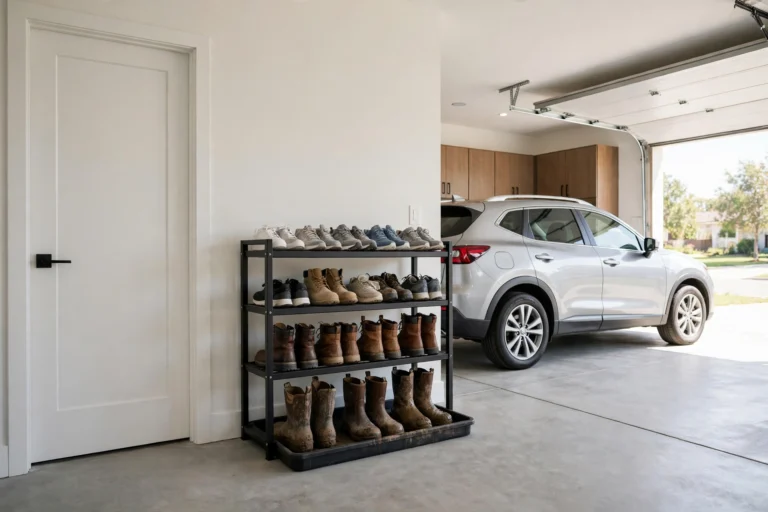
Freestanding steel or wire shelving does the heavy lifting in most garages. A unit runs about $60 to $150, stands 18 to 24 inches deep, and is rated 250 to 1,000-plus pounds per shelf. Edsal, Seville Classics, Trinity and Husky cover the range. The heavy-duty Edsal units go up to 4,000 pounds per unit. Wire shelves are easy to clean and you can see through them. Solid steel shelves hold more and do not let small things fall through.
Put shelving against the wall you do not need for the cars, and keep it 18 inches deep at most. Deeper shelves swallow things. The back half becomes a place where bins go to disappear. Label the front edge of every shelf, and keep the things you use most at waist height, not on the top shelf where you need a step stool.
One shelving unit and a 6-pack of clear bins, about $25 to $45, is the core of the starter kit in the cost section below. Clear bins matter. You can see what is inside without opening six boxes to find the one you want.
OVERHEAD STORAGE: THE BEST OVERHEAD GARAGE STORAGE RACK
The ceiling is the biggest unused space in the garage, and it is the only part of this guide where getting it wrong is dangerous. A loaded rack holds several hundred pounds over a car. Buy the right rack and install it into joists, or do not install one at all.
The best overhead garage storage rack for most homes is a 4 by 8 foot steel rack. It costs about $100 to $250 and is typically rated 500 to 800 pounds. A 4 by 8 deck fits six standard 27-gallon totes in a single layer, two rows of three. A real 27-gallon tote runs about 28 to 30 inches by 20, so measure your totes before you buy the rack, not after.

Fleximounts and SafeRacks are the two lines carried nearly everywhere. Fleximounts is the dominant brand for a reason. The Classic model holds 750 pounds on a 4 by 8 platform. The Pro bumps that to 800. The Max tops out at 1,000 pounds. SafeRacks makes a 4 by 8 rack rated at 600 pounds, and its Costco 2-pack deal, about $200 for two racks, is the best per-unit value around at $100 a rack.
The weight rating only holds if every upright is lagged into ceiling joists with the hardware in the box. Find the joists with a stud finder and confirm with a drill. Fastening into drywall is not a reduced capacity. It is no capacity at all. The same goes for the diagonal web members of an engineered roof truss. If your ceiling has trusses rather than joists, check the rack’s instructions before you buy. Some racks require wood joists and prohibit I-beams, steel joists and concrete ceilings outright.
So what belongs up there? The stuff you touch two to four times a year. Holiday decorations, camping gear, ski gear, seasonal bins. And what stays down? Anything you need weekly. Anything too heavy to lift over your head without hurting yourself. Anything that hates heat, because the ceiling is the hottest spot in the garage come July. An overhead rack is the best value storage you can add. But only if the right things go on it, and the wrong things stay off.
CABINETS: WHEN DOORS BEAT OPEN SHELVES
Open shelves are cheap and fast. Cabinets are for the things shelves cannot handle: chemicals, automotive supplies, power tools you want locked away, and anything you want to keep dust off. Steel cabinets run about $150 to $500 per unit. Gladiator and Husky are the mainstream lines, and NewAge Bold Series is the premium one at $1,399 and up for a set.
Husky, sold at Home Depot, is the most popular choice for the value-conscious buyer. Good build quality, available everywhere. Gladiator, made by Whirlpool, is the only brand that covers the whole garage: slatwall, track, overhead racks and freestanding cabinets with a 2,350-pound capacity. NewAge Bold Series is fully welded 24-gauge steel, lockable doors on every piece, with 46-plus configurations. Its base cabinets hold 600 pounds total and 200 pounds per shelf.
Buy cabinets when you need enclosed storage. If everything you store is fine sitting out in the open, shelves cost a third as much and hold more. Cabinets earn their money on chemicals, valuables and anything small children should not reach.
BIKES AND SPORTS GEAR
Bikes are the single hardest thing to store in a garage, because they are long, awkward and used often enough that you do not want them overhead. The answer is the wall, not the floor.
A wall-mounted bike hook on a track system holds the bike by one wheel, flat against the wall, and it costs next to nothing. Two bikes on a track take about four feet of wall. Got four bikes in the family? A track section plus hooks still beats any freestanding rack on price, and it eats zero floor space. Ceiling hoists exist too, and they work fine, but only for the bike you ride a few times a year. Hoisting the one you ride twice a week? That gets old within a month.
Same idea for sports gear. Balls, bats and rackets go in a tall bin or a wall basket, right by the door the kids actually walk through. Skis and fishing rods go high on the wall, flat on two hooks. Quick test: can a kid grab it and put it back without calling you for help? Then it is stored right. Does it end up on the floor every single time? Then it is stored wrong, and no tidy basket changes that.
SMALL GARAGE SOLUTIONS
A small garage does not need smaller ideas. It needs the same ideas, pushed harder. Everything goes up. The ceiling rack matters more, not less, because there is no floor to spare. A 4 by 6 foot overhead rack fits garages where a 4 by 8 will not, and Fleximounts makes both sizes.
Small garage storage ideas that actually help: a folding workbench that drops flat against the wall when you are done, narrow 12-inch shelving on the wall you never park against, and one wall of slatwall instead of shelves scattered on three walls. The rule is one wall, fully used, beats three walls half used.
Small garage organization is the same problem from the other side, and it gets its own article next. The short version: own less, give everything a marked home, reset for 15 minutes once a month. A small garage punishes clutter faster than a big one. That is why the sort matters more than the shopping, every single time.
WHAT IT COSTS
Here is what the whole job costs at those ranges, so you can pick a tier and stop guessing.
Figure about $115 to $255 for the starter kit. A 4 by 4 pegboard with hooks, $30 to $60. One steel or wire shelving unit, $60 to $150. A 6-pack of clear bins, $25 to $45. Add it up and you have got a tool wall, a bin wall and a labeling system. For most garages that is genuinely enough to fix the whole mess.
A full makeover, about $285 to $745: a 4 by 8 slatwall section ($100 to $300), an overhead rack ($100 to $250), a steel shelving unit ($60 to $150) and a 6-pack of clear bins ($25 to $45). That is wall, ceiling and floor storage in one job.
Doing the full wall-and-ceiling system yourself runs roughly $500 to $1,500. How much depends on how many shelves, cabinets and racks you add, what your walls are made of, how much wall you cover, and whether cabinets join the list. Add a cabinet set and you are past $1,000 before you know it. My honest advice: start with the starter kit, live with it for a month, then buy the next piece. The first month shows you what is actually missing, so the second purchase is the right one.
WHAT TO AVOID
Five mistakes that waste money or create a hazard.
Buying before sorting. Storage for things you should have thrown away is money in the trash. Sort first, buy second.
Hanging an overhead rack into drywall. The rating means nothing without joists. If you cannot find joists, do not hang the rack.
Blocking the garage door rails. Shelving or racks that stick out past the door track will catch the door or block it. Measure the door’s travel before you place anything near it.
Bins without labels. A wall of identical grey totes is a wall of mystery boxes. Label every bin on two sides, so you can read it from any angle.
Floor piles. Anything that lives on the floor becomes a trip hazard and a parking problem. If it has been on the floor for a month, it needs a home on a wall or it needs to leave.
FAQ
What is the cheapest way to organize a garage?
Start with a sort, then a 4 by 4 pegboard with hooks ($30 to $60), one steel shelving unit ($60 to $150) and a 6-pack of clear bins ($25 to $45). That starter kit runs about $115 to $255 and fixes most garages.
What is the best overhead garage storage rack?
For most homes, a 4 by 8 foot Fleximounts rack. The Classic holds 750 pounds, the Pro 800 and the Max 1,000. SafeRacks is the value pick, especially the Costco 2-pack at about $200. Whatever you buy, the rating only holds if it is lagged into ceiling joists.
How much weight can an overhead garage rack hold?
A standard 4 by 8 rack is rated 500 to 800 pounds, depending on the model. Fleximounts Max goes to 1,000 pounds. The rating assumes every upright is fixed into joists with the supplied hardware. Into drywall, the capacity is zero.
How do I store bikes in a garage?
On the wall, on a track system with bike hooks. Two bikes take about four feet of wall and no floor at all. Ceiling hoists work only for bikes you ride a few times a year.
Do I need cabinets or are shelves enough?
Shelves are enough for anything that is fine sitting out in the open. Buy cabinets for chemicals, automotive supplies, power tools you want locked away, and anything you want to keep dust off or away from children.
How do I store things in a small garage?
Push everything up. A 4 by 6 overhead rack where a 4 by 8 will not fit, narrow 12-inch shelving on one wall, a folding workbench, and one wall of slatwall used fully instead of shelves scattered on three walls.
What size overhead rack fits a two-car garage?
A 4 by 8 foot rack is the standard size. It fits six 27-gallon totes in one layer, two rows of three. Measure your totes first. A real 27-gallon tote runs about 28 to 30 inches by 20.
What should go overhead and what should stay on the wall?
Overhead is for the two-to-four-times-a-year stuff: holiday decorations, camping gear, seasonal bins. The wall takes the weekly stuff: tools, garden gear, sports equipment. Rule of thumb: if you need it every week, it never goes overhead.
How much does it cost to organize a garage?
A starter kit runs about $115 to $255. A full makeover, slatwall plus an overhead rack plus shelving, runs about $285 to $745. A full wall-and-ceiling system? Roughly $500 to $1,500, depending on how far you take it.
How do I keep the garage organized after the job?
Give everything a marked home, label every bin on two sides, and run a 15-minute reset once a month. That reset is the whole secret, really. Skip it and any system, no matter how good, slides back to piles within six months.
THE BOTTOM LINE
A garage gets organised by zones, not by shopping trips. Ceiling for the seasonal stuff, upper wall for the weekly tools, lower wall for cabinets, floor for the cars and nothing else. Sort first, measure second, buy third. Start with the $115 to $255 starter kit, live with it for a month, and only then buy the next piece. By then you will know exactly what is missing.
Once the storage is in place, the next job is the system that keeps it that way. That is our next guide: garage organization ideas, the budget-first system for sorting, zoning, labeling and a 15-minute monthly reset.



7 Comments