
Garage Ceiling Storage: Overhead Racks That Actually Work
Garage Ceiling Storage Ideas That Free Your Floor

Garage ceiling storage is the space you already own and never use. Every garage has eight or ten feet of empty air above the cars, and an overhead rack turns it into storage for the seasonal stuff — holiday decorations, camping gear, anything you touch two to four times a year. The floor stays clear, the cars stay inside, and nothing you need daily is ever out of reach.
This guide covers the three ways to store overhead — fixed racks, hoists and platforms — with real weight limits, the joist safety rules that matter most, sizes, and prices. By the end you will know what your ceiling can hold, what it cannot, and what the right setup costs.
WHAT BELONGS UP THERE
The rule is simple: if you touch it less than four times a year, it can live on the ceiling. Holiday decorations, camping gear, seasonal sports equipment, the spare tire, the roof box. These are bulky, light for their size, and you never need them in a hurry.

The rule has a second half: if you touch it weekly, it stays on the floor. Tools, paint, cleaning supplies, the kids’ bikes — all of these belong on shelves or hooks at eye level. A ceiling rack is the wrong home for anything you need in a hurry, because every trip up a ladder is a trip you will skip. Our garage shelving guide covers the floor-level storage that handles the daily stuff.
And some things never belong up there at all. Paint cans and batteries hate heat — a garage ceiling in summer hits 120 degrees, and paint stored there goes bad in one season. Anything liquid, anything that melts, and anything heavier than you can lift over your head with both hands stays downstairs.
THE THREE TYPES, COMPARED
A fixed overhead rack is the standard: a steel frame that bolts into the ceiling joists, with a wire or solid deck, holding grey totes. A 4 by 8 foot rack runs about $100 to $250 and holds 500 to 800 pounds. It never moves, it never needs power, and it holds the most for the least money. Buy a fixed rack for seasonal bins.

A hoist or lift is a platform that lowers to the floor on cables, you load it, and a winch or motor pulls it back up. A manual hoist runs about $200 to $400, a motorized lift about $300 to $500. It holds 200 to 400 pounds, less than a fixed rack, but you never climb a ladder — the platform comes to you. Buy a hoist for kayaks, bikes, or anything heavy that one person loads alone.
A platform or loft is a permanent wooden deck built across the ceiling joists, usually above the garage door. It costs about $500 to $1,500 in lumber and hardware, holds as much as the joists allow, and gives you the most space of all. Buy a platform when the whole ceiling is free and you want a full second floor of storage.
HOW MUCH WEIGHT CAN THE CEILING HOLD?
This is the question that decides everything, and the answer is not the rack’s rating. The rack might be rated for 800 pounds, but the ceiling is rated for what the joists can carry. A standard garage ceiling joist holds about 10 pounds per square foot of dead load — the weight of the ceiling itself plus whatever hangs from it. A 4 by 8 foot rack spreads its load over 32 square feet, so the joists under it can safely carry about 300 pounds of stored stuff, even if the rack itself is rated for twice that.
The safety rule is simple: bolt into joists, never into drywall. Into joists, a rack holds hundreds of pounds. Into drywall, it holds zero — drywall is paper and gypsum, and a loaded rack pulls straight out of it. Find the joists with a stud finder, mark them with painter’s tape, and use lag bolts, not screws. A lag bolt in a joist holds a hundred pounds. A screw in drywall holds a picture frame.
And spread the load across at least four joists, never two. Two joists carry the whole weight on two points, and the ceiling sags between them. Four joists share it, and the ceiling stays flat. If your rack is wider than the joist spacing, that is a good thing — it means it crosses more joists.
SIZES AND CLEARANCE: MEASURE TWICE
Three numbers decide the size. The joist spacing, usually 16 or 24 inches on center. The space above the open garage door, which is where most racks live. And the clearance above the tallest car, because a rack that hangs too low turns the garage into a one-car garage.
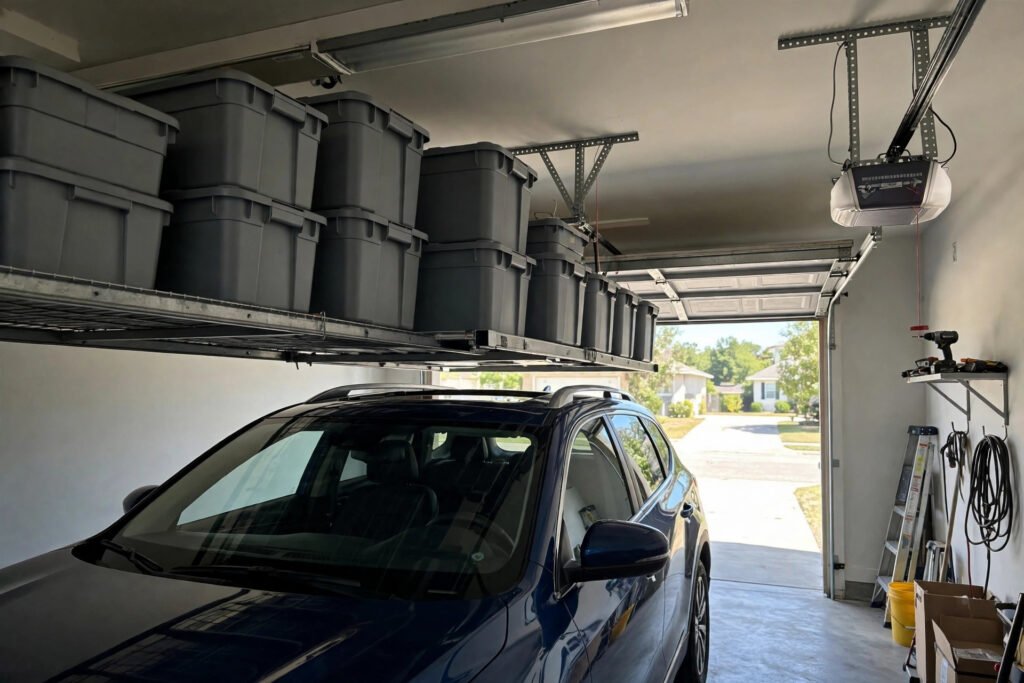
The standard sizes are 4 by 4 feet, 3 by 6 feet, and 4 by 8 feet. A 4 by 8 rack holds four large totes side by side and fits above most cars. A 4 by 4 rack fits above the garage door, where the ceiling is highest and the door track leaves a dead space no car ever uses. Measure the space above your door first — it is free storage hiding in plain sight.
Clearance is the number people forget. Park the tallest car in the garage, close the door, and measure from the roof of the car to the ceiling. You need at least 12 inches of gap between the car roof and the bottom of a loaded rack, or you will clip the rack every time you load a tote. Most racks hang 22 to 40 inches below the ceiling, adjustable in 3-inch steps — set it high enough to clear the car, low enough to reach from a step stool.
And check the garage door opener. The opener rail runs down the middle of the ceiling, and a rack cannot cross it. Measure the rail, then put the rack to one side of it. A rack that blocks the opener rail is a rack that has to come down.
HOISTS AND LIFTS: NO LADDER NEEDED
A hoist earns its money on one thing: you never climb a ladder. The platform lowers to the floor on steel cables, you load the kayak or the bikes at waist height, and a hand winch or a small motor pulls it back up. A manual winch hoist runs about $200 to $400, and a motorized one about $300 to $500.

The tradeoff is weight. A hoist holds 200 to 400 pounds, about half what a fixed rack holds, because the cables and the winch are the weak point, not the ceiling. And a hoist needs the ceiling space directly above where you load — you cannot slide it sideways once it is up. Buy a hoist when the load is heavy and awkward, and one person has to load it alone.
Two things to check before you buy a hoist. First, the cable length: it must reach the floor with the platform level, or you will load it tilted. Second, the lock: a good hoist locks at the top with a pin or a brake, so a slipped cable does not drop the platform. Never trust a winch alone to hold the load — always use the lock.
PLATFORMS AND LOFTS: A SECOND FLOOR
A platform is a wooden deck built across the joists, usually above the garage door, turning dead air into a full loft. It costs about $500 to $1,500 in lumber, plywood and hardware, and it gives you the most storage of any ceiling option — a 8 by 12 foot platform holds more than three 4 by 8 racks.
The catch is access. A platform needs a ladder or pull-down stairs, and everything on it comes down by hand, one tote at a time. It is the right call when the stuff is light and truly seasonal — holiday decorations, camping gear, the roof box. It is the wrong call for anything heavy, because every heavy tote is a ladder trip with a bad back waiting to happen.
Build it right or do not build it. The deck must sit on the joists, not hang from them, and the load must spread across at least six joists. If the joists are 24 inches apart, add blocking between them — short pieces of lumber nailed between the joists that stop them from twisting under load. A platform without blocking sags in the middle within a year.
INSTALLATION: FIVE STEPS, ONE AFTERNOON
A fixed rack goes up in five steps. First, find the joists with a stud finder and mark them with painter’s tape — every mounting point must land on a joist. Second, hold the rack frame against the ceiling and mark the bolt holes through the frame. Third, drill pilot holes into the joists, smaller than the lag bolts, so the wood does not split. Fourth, bolt the frame up with lag bolts and washers, and tighten each one until the washer bites into the metal. Fifth, load it light first — put the empty totes up, check that nothing sags overnight, and only then load it full.
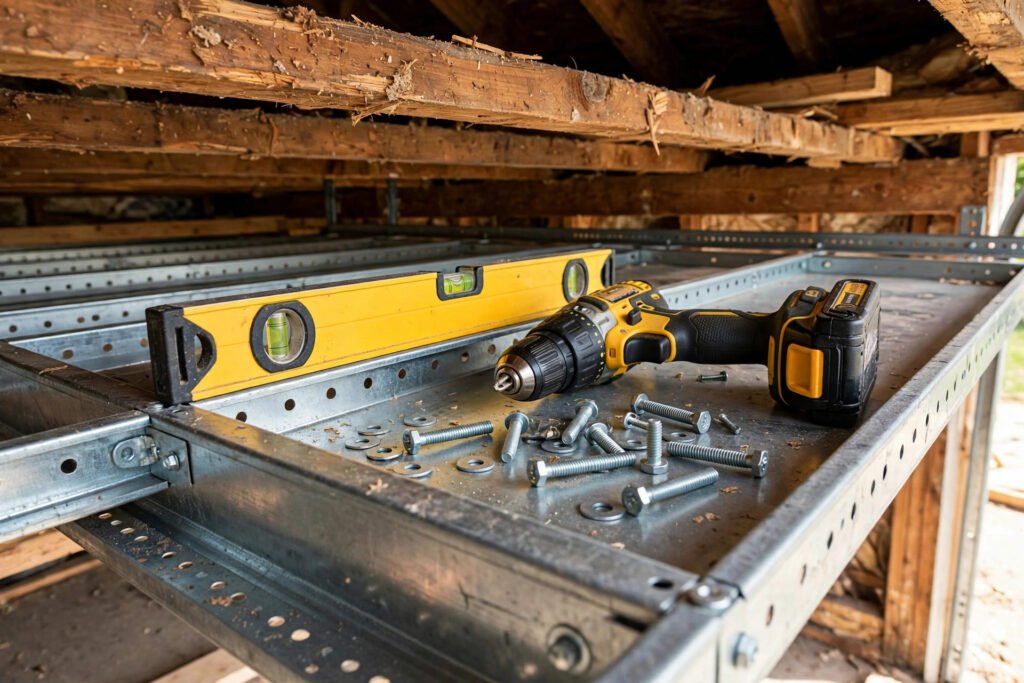
The step people skip is the overnight test. A rack that looks fine at noon can sag by morning if a lag bolt missed the joist and bit only drywall. Load it light, sleep on it, and check the bolts in the morning. A rack that has not moved overnight will not move in a year.
WHAT NOT TO STORE UP THERE
Three things never go on the ceiling. Paint and chemicals, because summer heat ruins them and a leak drips onto the car below. Batteries, because heat kills them and a leaking battery drips acid. And anything you need in a hurry — the ladder itself, the emergency kit, the snow shovel in winter. The ceiling is for the stuff you forget about for months, not the stuff you reach for weekly.
WHAT IT COSTS
A starter setup — one 4 by 8 foot fixed rack and four large totes — runs about $160 to $350. A hoist setup for kayaks or bikes runs about $250 to $550. A full ceiling — two racks plus a platform above the door — runs roughly $600 to $1,800.
The honest advice is the same as every article in this series: start with one rack, live with it for a season, and only then buy the next piece. The first season shows you what is actually missing, so the second purchase is the right one.
FREQUENTLY ASKED QUESTIONS
How much weight can a garage ceiling rack hold?
A 4 by 8 foot rack is usually rated for 500 to 800 pounds, but the ceiling decides the real limit. Standard joists safely carry about 10 pounds per square foot, so the same rack holds about 300 pounds of stored stuff in most garages. Always check your joists before trusting the rack’s rating.
Is garage ceiling storage safe?
Yes, when it is bolted into joists with lag bolts and the load is spread across at least four joists. It is not safe when it is screwed into drywall, hung from two joists only, or loaded past what the joists can carry. Test it light overnight before loading it full.
Will a ceiling rack damage my ceiling?
No, if it is installed correctly. Lag bolts into joists do not damage the ceiling, and the load spreads across several joists. Damage happens when a rack is screwed into drywall, which tears out, or when it is overloaded and the joists sag.
How high should a ceiling rack be above the car?
Leave at least 12 inches between the car roof and the bottom of a loaded rack. Most racks hang 22 to 40 inches below the ceiling and adjust in 3-inch steps, so set it high enough to clear the car and low enough to reach from a step stool.
What size ceiling rack do I need?
A 4 by 8 foot rack holds four large totes and fits above most cars. A 4 by 4 foot rack fits above the garage door, where the ceiling is highest. Measure the space above your door and the clearance above your tallest car before you buy.
Can I install a ceiling rack myself?
Yes, with a stud finder, a drill, and a second pair of hands to hold the frame. The work is one afternoon. If you are not comfortable drilling into joists, hire a handyman — the job takes a pro about an hour.
What should I not store on a ceiling rack?
Paint, chemicals and batteries, because summer heat ruins them. Anything liquid that could leak onto the car below. And anything you need weekly — tools, cleaning supplies, the snow shovel. The ceiling is for seasonal stuff only.
How much does garage ceiling storage cost?
One 4 by 8 foot fixed rack runs about $100 to $250. A manual hoist runs about $200 to $400, a motorized lift about $300 to $500. A starter rack with totes runs about $160 to $350.
Rack or hoist — which is better?
A fixed rack holds more for less money, about 500 to 800 pounds for $100 to $250. A hoist holds less, about 200 to 400 pounds, but the platform comes down to you, so you never climb a ladder. Pick the rack for bins, the hoist for kayaks and bikes.
Does ceiling storage work with a garage door opener?
Yes, as long as the rack does not cross the opener rail. The rail runs down the middle of the ceiling, so put the rack to one side of it and measure the rail before you buy.
THE BOTTOM LINE
Garage ceiling storage works when the rack matches the joists. Fixed rack for seasonal bins, hoist for kayaks and bikes, platform for a full loft. Bolt into joists with lag bolts, spread the load across four joists or more, leave 12 inches above the car, and test it light overnight.
Once the ceiling is working, the floor is the next job. Our garage shelving guide covers the steel, wire and wood shelves that hold the daily stuff, and our garage organization ideas guide covers the sort, the zones and the labels that keep the whole garage working as one system.


2 Comments